
















































By Moses Asiimwe
Traditional music and dance have been an integral part of Rwandan ceremonies, festivals, social gatherings and storytelling since the pre-colonial era, as they are today. This overview text covers some of the main features of traditional music and dance (sometimes referred to as gakondo) in Rwanda.
Pre-colonial music
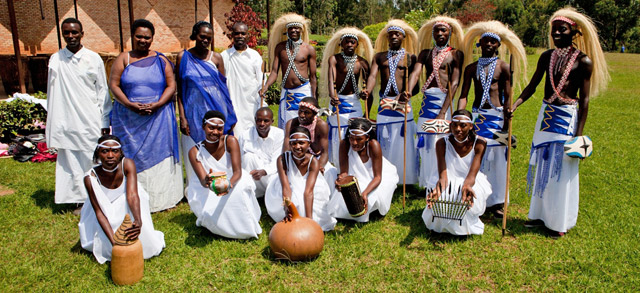
The most famous traditional dance is intore and amaraba, a highly choreographed routine consisting of three components: the ballet, performed by women; the dance of heroes, performed by men, and the drums. Usually men are helped by women in performing the amaraba dance. Men beat drums in groups of seven to nine. This was the order of Rwandan traditional music blessed by the umwami, a king of Rwanda in the pre-colonial period.
Chiefs in the kingdom established some of the warfare dances. This led to the birth of famous dances that featured elegant female dancers, including umushayayo, umushagiriro and the warfare dance umuhamiriza. The most famous groups among them were the Abangakurutwa, Ahogororangigo and Amariza. As for the male groups, older people still had their place in traditional dances; Intore, a tradition that developed in troops like lshyaka, Indashyikirwa, lndemarugamba and lmbasharugamba, all of which are meant to boost the morale of troops during warfare.
When it came to ceremonial events, Rwanda had three major dances (kwiyereka): kwiyireka umuheto, dancing in honour of a bow; kwiyereka ingabo, dancing in honour of a shield; and kwiyereka icumu: dancing in honour of the spear. Some of these dances have been adapted to contemporary dances while others have been lost.
Key features of Rwandan traditional music and dance
Rwandan music and dance are unique. What most distinguishes Rwandese music from other African music is the use of a 5/8 rhythm. Before most traditional music is played, family members gather together in the evening for igitaramo, literally meaning company. Then they dance, sing and boast about what they had accomplished during the day. While dancers dance, members of the chorus clap their hands to add rhythm and to cheer and encourage the dancers. Usually this clapping group is composed of female and male vocalists and can support dancers with flowing choruses. These gatherings are usually concluded by locally brewed beer.
Dance is inseparable from music and is one of the most spectacular expressions of the Rwandan culture. Rwandan dancers always dance collectively. The distinction is often made between warlike and ordinary dances. Ordinary dances take place mainly during the many festivities, within family circles or in public during spiritual celebrations. Traditional music of Rwanda is dominated by ikinimba. It tells stories of heroes and kings. The dance is a show of strength and stamina, specifically for cattle farmers, and is performed to celebrate the harvest. It is accompanied by instruments like ingoma, ikembe, iningiri, umuduri and inanga. Another dance, imishayayo, is a very soft dance used to gently rock someone.
Warlike or warrior dances employ the same movements as those used in actual fighting. These include the imyiyereko parade, where dancers imitate warfare movements, charging towards one or many enemies, and the umuhamirizo dance, considered by many to be the most spectacular. Intore is a sort of war dance which encourages those who wage war or hunt. Intore means ‘the elite’ or ‘leader’. Intore dancers are selected based on moral and physical qualities. They are trained for some time. During their training, not only do they learn to dance but they also receive education in moral values. However, nowadays all young people are taught these values regardless of being Intore.
One of the oldest Rwandan music and dance groups is the Intore Dance Troupe. The Intore (literally meaning ‘chosen ones’) were founded several centuries ago, when they performed at the court of the Rwandan mwami or king. Today, they perform in most ceremonies including weddings, birth celebrations, traditional baptism (guterekera), anniversaries, launching of new projects, political parties or the welcoming of important visitors. Elsewhere, dance groups like Ballet National Urukerereza, created in the early 1970s to represent Rwanda at international events, Amasimbi n'amakombe of the late Rugamba Sipirian and Irindiro of Bikindi Simon have been the training grounds for Rwandan traditional music and dance.
The traditional dances are always accompanied by traditional songs, known as indirimbo in Kinyarwanda. Indirimbo songs consist of many categories, the most popular being those in praise of a dynasty (urugera), pastoral songs (amahambo), choral songs (ibihozo), lullabies, love songs, songs of complaint, hunting songs (amahigi) warriors’ songs (indirimbo z'ingabo), songs accompanying war dances (indirimbo z'intare) and wrestling songs (amusare).
Traditional Instruments
All the songs and dances outlined above are performed with the help of traditional musical instruments, which are unique to the country. Perhaps best known is, a traditional stringed instrument similar to a lyre or harp. It has 9 or 12 strings (made from cow skin), and the resonator is made from a wood called umyungu. The inanga has been played by many of Rwanda's best-known performers, such as Sentore Masamba, Maitre de Rujindiri, Thomas Kirusu, Sebatunzi, Sophie Nzayisenga, Victor Kabarira, Daniel Ngarukiye, Jules Sentoré, Simon Bikindi, Rwishyura, Simparingoma and Emmanuel Habumuremyi. Other traditional chordophones include the umuduli (a single-stringed traditional bow), inigiri (a violin-like instrument played with an umuchiri or bow) and icyembe (a music box with acoustic strings on it).
Drums are called ingoma, and the drum heads are made of cow skin. Aerophones include urusengo (bamboo flute), umwirongi (a flute made of lobelia), amakondera (a horn used to play a smooth, long-drawn echoing sound) and amahembe (trumpets made of antelope horns). Idiophones include ikembe (a local version of the mbira or kalimba), ikinyuguri or urunyege (rattle), urutaro or intara (winnowing basket) and amayugi (small spherical belts attached to dancers’ ankles). Musical bows and instruments with metallic strips were introduced fairly recently – around the end of 19th and beginning of the 20th century.
Traditional music today
When the genocide against the Tutsis took place in 1994, the music industry was brought into total disarray. Many traditional musicians were killed in 1994 along with other Tutsis. Stars at the time like Andre Sebanani, Rugamba Sipirian, Orchestre Impala and several others lost their lives. The genocide led many Rwandans to move overseas in the early 1990s, taking their country's music to cities like Brussels and Paris. For many years, Rwandan-Belgian Cécile Kayirebwa was arguably the most internationally renowned Rwandan traditional musician, until other stars started emerging, such as Jean-Paul Samputu in Canada in the late 1990s.
Since then, Rwandan traditional music has graced world stages. Samputu, for example, along with his group Ingeli won two Kora Awards in 2003 for Most Inspiring Artist and Best Traditional Artist for their performance of neo-traditional Rwandan music. Cyprien Kagorora was nominated for a 2005 Kora Award in the category of Best Traditional Artist. He remains among the most recognizable male vocalists in Rwanda.
Though Rwanda has different kinds of music today, traditional music still stands as an essential part of Rwandan culture. Any visitor to the country will be welcomed by the sounds and rhythms of ingoma, inanga, umuduli, iningiri and icyembe. One should definitely not miss experiencing some live dance performances and the beautiful sounds of traditional groups.
Traditional Rwandan music continues to evolve and is increasingly influenced by western music. For example, the traditional instruments outlined above are today often accompanied by more modern instruments. Important to note too is that all Rwandans share the same musical heritage, just as they share a common language, values and rituals. Unlike in most other parts of Africa, the traditional music outlined above is not associated with particular ethnic or regional groups, but truly representative of the nation as a whole.
Further Reading:
- Briggs, P. & J. Booth. 2006. Rwanda: The Bradt Travel Guide (3rd ed.). London: Bradt Travel Guides.
- Jacquemin, J-P., J. Sezirahinga & R. Trillo. 2000. "Echoes from the Hills". In Broughton, S. and Ellingham, M. (eds.), World Music, Vol. 1: Africa, Europe and the Middle East. London: Rough Guides/Penguin Books. pp 608–612.
- Our Africa. “People & Culture: Dancing to the Bear”. Accessed from <http://www.our-africa.org/rwanda/people-culture>
- Rwanda Direct. “History: Music”. Accessed from <http://www.rwanda-direct.com/rwanda-intore-dancers/history/>
- Tukabyine.com. 2012. “Rwandan Music: Inanga, Rwandas most important musical instrument”. Accessed from <http://www.tukabyine.com/styles/2096/rwanda-inangarwandas-most-important-music-instrument/#sthash.UxbXEV37.dpuf


Most popular

Top amapiano songs of 2026
16 Feb 2026

Top Afrobeats songs of 2026
19 Mar 2026
AFRIMA 2026: All the winners
12 Jan 2026
Open call: Goethe-Institut grants for Southern African creatives
08 Sep 2026
Call For Applications : ACCES seeks a UK-based performer
10 Sep 2026

Top Naija songs of 2026
31 Mar 2026
Sun-El Musician confirmed for ACCES 2026 in Joburg
15 Sep 2026
Disclaimer: Music In Africa provides a platform for musicians and contributors to embed music and videos solely for promotional purposes. If any track or video embedded on this platform violates any copyrights please inform us immediately and we will take it down. Please read our Terms of Use for more.

Subscribe to our monthly Newsletter
Follow us on social media


Please log in to post a comment.