



















































The rising popularity of brass bands in the past 10 or 15 years has been a phenomenon almost completely unchecked by the media and commercial music industry alike. There's little mention of the brass band scene when the pages of mainstream music magazines and websites are examined, and it takes someone as popular as Beyoncé, flanked by six flatulating sousaphones at Coachella, to make one realise that the brass band may just be the thing modern music fans have been longing for without knowing what that thing really is.
NPR's Tiny Desk Concert series is probably the only bigger platform that features brass ensembles, such as Fanfare Ciocărlia, Dirty Dozen Brass Band, No BS! Brass Band, Red Baraat and The Soul Rebels with Wu-Tang Clan founding member GZA. Hypnotic Brass Ensemble, on the other hand, has worked with Mos Def, Damon Albarn, Prince, Snoop Dog, Erykah Badu and Tony Allen, to name a few, proving that a solid brass band can do wonders for musicians from a variety of genres and their respective sounds.
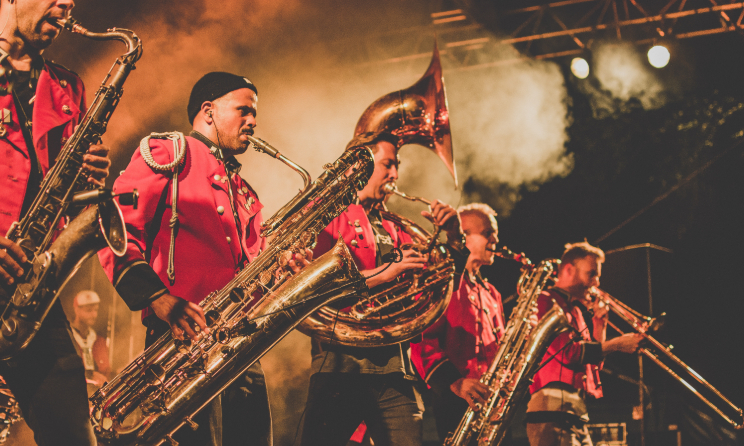
In Germany and Europe, brass band Meute has been attracting a great deal of attention with its renditions of electro tracks by DJs and producers such as Dennis Ferrer, deadmau5, Trentemøller and Flume. Hailing from the northern German city of Hamburg, the 11-piece ensemble is now a favourite on the European summer festival circuit, and its videos, most of which are shot in public settings, are amassing millions of views for their dynamic complexity and unbridled energy.
The band will be in southern Africa this week with performances at The Good Luck Bar (Johannesburg, South Africa, on 23 May), Zakifo Festival (Durban, South Africa, on 24 May) and MTN Bushfire (Malkerns Valley, eSwatini, on 25 May). The southern African dates are part of Meute's upcoming tour of 31 performances, which include the coveted WOMAD and Pukkelpop festivals.
In Johannesburg, Meute will be joined by Bombshelter Beast, the Marcus Wyatt-led brass ensemble, which has been drawing impassioned crowds with its fusion of kwaito, Balkan, klezmer, hip hop and dub.
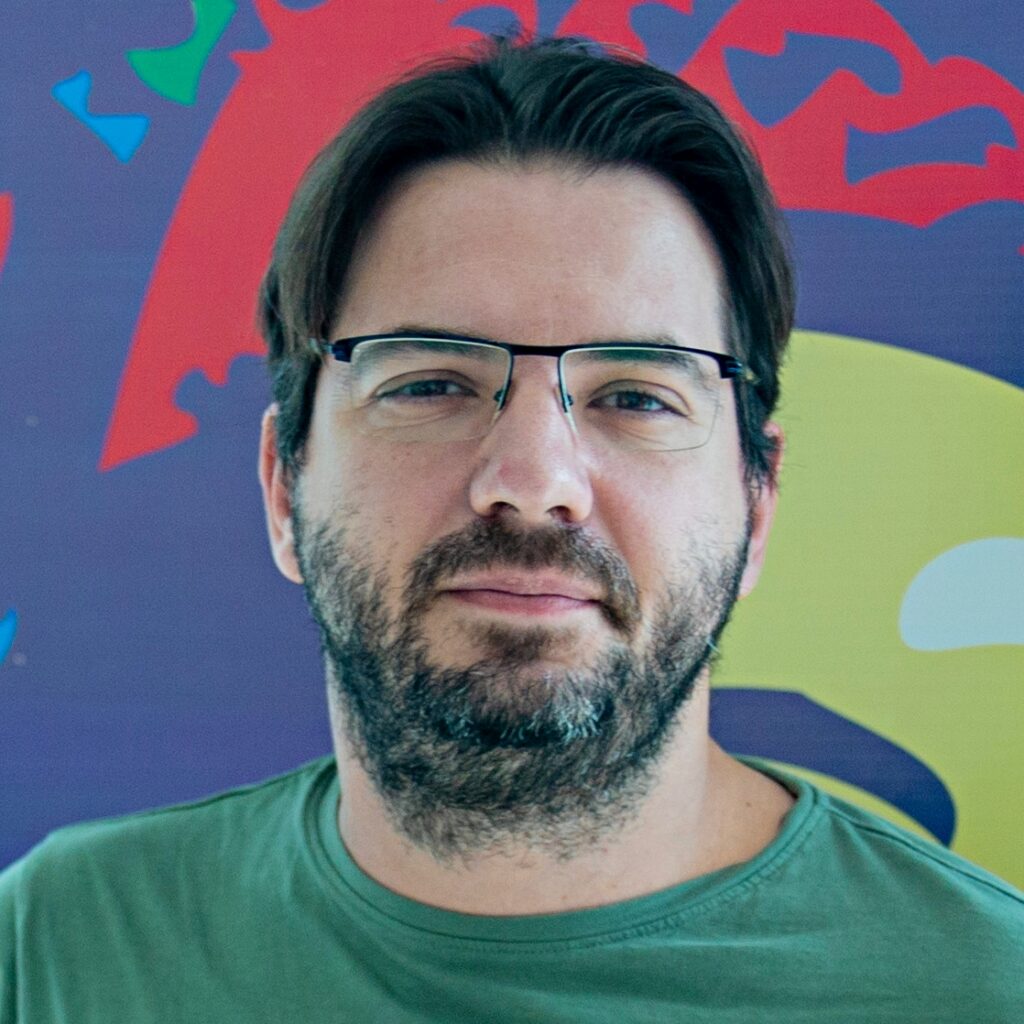
Music In Africa spoke to Meute founder and bandleader Thomas Burhorn about the band's sound, its tour to southern Africa, and the idea behind creating a brass band that ravers can go nuts to like it's the '90s.
MUSIC IN AFRICA: Did you ever imagine that Meute would be the monster it is today when the band came together in 2015?
THOMAS BURHORN: [Laughs] Monster is a beautiful word. We always thought that there was big potential in the chemical reaction between these two high energetic elements: the directness of an acoustic marching band together with the archaic simplicity of techno music. We thought that this could be huge. But of course, we didn't expect that so many people would also love the idea.
The street performance component is a big thing for Meute. The idea that you might 'hook' unaware listeners who could become lifelong fans must be thrilling.
The good thing with street art is that you have the most honest audience. When your performance is not interesting, the people just leave. It's only when the performance is great that they stay. That gives you the possibility to try out different things. And we love the direct contact when audience and band interact with one another.
Tell us about what it is like to be a musician in Hamburg, compared to other cultural capitals in Europe like Berlin, Paris, London and so on.
Hamburg, with its population of 2 million, has a very lively music scene. Because of the harbour, it has always been very cosmopolitan. There is a big red-light district, St Pauli, and we have many theatres, musicals, live clubs, a big opera house, and when you want to go out on the weekend, there are many possibilities, be it punk, soul, rock or techno. Of course this is a good playground for different musicians of different flavours. Even The Beatles shaped their style and their performances and became famous with their more than 100 shows in the early 1960s in Hamburg.
Your performances are all about serious bass and brass energy. Is it sometimes a challenge to keep that energy going consistently throughout a whole performance?
Once we start, the power of the music and the smiles of the dancing people around us gives us all the energy we need!
How significant was the Internet in forging Meute's career? Would Meute have been as successful had it not been for the viral properties of the Internet?
Maybe the Internet helped us a bit, but our most powerful marketing tool is to play concerts and share our energy with the people.
You almost exclusively record and perform remakes of electronic/house music. In many cases your renditions are an improvement of the original. What's the secret to choosing the right composition to remake? Are you looking out for specific elements that can be easily translated to a brass set-up?
With our project we also try to find out what the important elements of electronic music are. Is it just the electronic sounds or is it also a special way of composing music? We always try to find tracks where the compositions are very electronic and where we believe that they still sound like techno, even with our acoustic instruments. Bus most importantly, the tracks have to touch our hearts and souls.
There has been increasing interest in brass bands in the past few years, whether Balkan brass bands or more contemporary groups such as Meute. Why do you think there is this interest?
Brass bands have always drawn big attention from people because it's such a powerful sound, and it looks great with the big sousaphone, the powerful drums and the glittering brass instruments. Especially today, where robots are taking our jobs and music is made by computers, people like to hear and feel the real and direct sensation.
You've done live collaborations with Stephan Bodzin and Laurent Garnier. Have you considered adding a permanent live DJ to your set-up to create an even more out-of-this-world experience for your fans?
Maybe one day. But for now, we think that we are out-of-this-world enough [smiles].
DJ performances have been criticised by many for their lack of performative prowess (watch me play my Mac). What Meute has done is reverse engineered electro music to provide a 'real' live performance for the audience – one which doesn't necessarily rely on lighting, projections and pyrotechnics to fill the performative void. Was that a conscious decision when you were conceptualising Meute?
We love performances by good techno DJs because they don't fake anything with a big pretentious performance. When they are really good, it's just about the music and not about the show. We try to deliver the same strength of music, but also add the fact that you can visually observe what we do and maybe feel the natural 'humaniser effect', because everything we do is handmade.
Is Meute influenced by African music? As you know brass instruments are central to many African genres, particularly in West Africa, like Afrobeat.
Techno music, marching band music, jazz, soul, house – we are aware that all the elements of our music are influenced by African music, and we love that fact. This is also why we are very excited to visit Africa for the first time.
What are you expecting from your upcoming gigs in southern Africa?
We are very curious to be on the continent, which has such a big influence on music history in the world and such a big influence on us. Apart from that, we hope that many people join us at the concerts and rave with us!
You will be playing with Bombshelter Beast in Johannesburg. Do you know anything about the band and what can the audience expect from your first performance in Johannesburg?
I just realised that I met one of the members on a totally different occasion some years ago, but honestly, I haven’t had time to dig deeper in their music. We are very curious. As for the Johannesburg audience, they can expect a really sweaty night with lots of dancing.
Are you familiar with South African house and gqom, and if so, can we expect a remake of a local track for the local audience?
I'm hearing about this genre for the first time. Which track would you recommend?
Meute’s southern African tour is made possible by Goethe-Institut South Africa.
Buy tickets to Meute's show in Johannesburg here.
Buy tickets to Meute's show in Durban here.
Buy tickets to Meute's show in eSwatini here.


Most popular
Gambia: Suntou Susso announce UK tour for ‘The Path of a Griot’
09 Oct 2026

Top amapiano songs of 2026
16 Feb 2026

Top Afrobeats songs of 2026
19 Mar 2026
Open call: 2026 Gender@Work music industry training in Johannesburg
09 Oct 2026

Top Naija songs of 2026
31 Mar 2026

Call for applications: ACCES 2026 Emerging Artist Spotlight Competition
01 Oct 2026
Disclaimer: Music In Africa provides a platform for musicians and contributors to embed music and videos solely for promotional purposes. If any track or video embedded on this platform violates any copyrights please inform us immediately and we will take it down. Please read our Terms of Use for more.

Subscribe to our monthly Newsletter
Follow us on social media


Please log in to post a comment.