


















































By Konin Aka
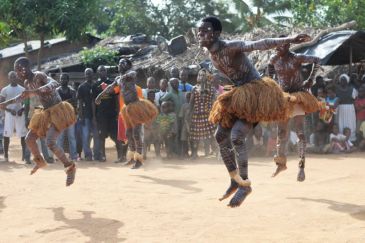
Located in West Africa, Ivory Coast is home to an ethnic mosaic that officially counts sixty ethnolinguistic groups. In relation to its cultural centers, Ivory Coast has a rich and diverse musical heritage. This is evidenced by the inscription of ‘AfounkahaGbofe of the Music of the Transverse Trumps of the Tagbana Community’ and ‘Djéguélé, pentatonic balafon of the Senufo of Ivory Coast’ on the Representative List of the Intangible Cultural Heritage of UNESCO the Ivory Coast.’ What are the components of this musical heritage?
Traditional musical instruments
Ivory Coast has an endless variety of traditional musical instruments. Despite their great diversity, the musical instruments used by the Ivorian population can in most cases fall into one of the traditional categories in use in the West. According to their acoustic principle, they are divided into idiophones, membranophones, chordophones or aerophones.
Apart from local musical instruments, there are also non-local instruments - instruments imported from the West (eg. brass, harmonicas, accordions) that have been integrated into traditional orchestras, musical accessories (eg. bells, cowbells) and other rhythm instruments. Idiophones and membranophones, more and more diverse in Ivory Coast, are very predominant in the south. On the contrary, in the North, one encounters more and more aerophones and membranophones.
Idiophones are instruments producing sounds by themselves. When used, the material from which they are made vibrates and produces a sound. The numerous instruments that reflect the idiophones category can be grouped according to their principle of resonance: they can be rattled, collided, scraped, shaken, pinched. This category of instruments is the richest and most widespread in Ivorian heritage. It includes several instruments, the main ones being resonating xylophones on banana trunks, wooden drums, bells, claves or clappers, rattles (calabash, basketry, box) rattles, bells, castanets, sanzas and water drums.
Membranophones are instruments where the sound is produced by the vibration of one or two stretched membranes, when beaten or, more rarely, rubbed. The drums are membranophones and are distinguished by the shape, the number of skins and the manner in which they are arranged. The drums in Ivory Coast have a resonant wooden box of clay, gourd or metal. They are of great variety: for example, drums pegged to a skin, drum laced with a skin, drum with two laced skins, armpit drums, hourglass pottery drums, gourd drums, frame drums, drums metal drum, and the timpani.
Membranophones (or strings) have strained strings resonating when pinched (by the fingers or a plectrum), rubbed, beaten or driven by the wind.Membranophones are often provided with a resonance body to enhance the sound. The calabash is primarily a sounding board for all strings except the lute that his wood. Membranophones that are represented in Ivory Coast are typically plucked or beaten. Among plucked instruments are lutes, harps, lutes, harps, musical bows, and traditional guitars. Hit string instruments include bark zithers.
Aerophones (also called air or wind instruments) are those in which a certain quantity of air is made to vibrate through or around it. Contained in a cavity, air can be moved by the straight edge through a pipe (eg. flute), by the action of a single reed (eg. clarinet) or by the vibration of the lips (eg. trumpets). In Ivory Coast, aerophones fall into two main groups: free and blown aerophones. Free aerophones include the rhombus and the 'whistle whirling’ observed by ethnomusicologist Hugo Zemp. As for blown aerophones, they range from trumpets (horns of cattle, ivory or wood)to flutes and whistles.
Traditional genres
Like its mosaic of ethnic groups, Ivory Coast has a diversity of traditional musical styles, which can be divided into two major categories:
- Sacred or ritual music: associated with ritual practices, often requiring initiation (men, women, children).
- Secular or popular music: a brand of ‘borrowed’ music that is often danced on the occasion of popular festivals, and also work music. The social status of traditional musicians
The musician, like any individual, is a member of society. He or she participates as such in the activities of man. But because of his or her musical specialization, his or her place is often different and very specific. Thus, in Ivory Coast, we have amateur musicians, semi-professional and professional musicians (eg. harp-lute players from Baoule), caste musicians (eg. djéli Malinke griots, Noumou Malinke blacksmiths, Senufo Fonon blacksmiths, Koulangodanlèse blacksmiths and musicians from some Akan societies), specialist musicians, freelance musicians, part-time musicians and solo musicians.
Conclusion
This overview text allows us to appreciate the richness and diversity of the musical heritage of Ivory Coast. But several threats to this intangible heritage exist - most notably the decline of traditions and the marginalization of traditional cultures, the rise in urban migration, new technology, urbanization, Westernization, and even the depletion of plant species used in the manufacture of music instruments and dance accessories.


Most popular

Top amapiano songs of 2026
16 Feb 2026

Top Naija songs of 2026
31 Mar 2026

Top Afrobeats songs of 2026
19 Mar 2026
Open call: Goethe-Institut grants for Southern African creatives
08 Sep 2026
AFRIMA 2026: All the winners
12 Jan 2026
Open call: 2026 Afro Pepites Show for artists
16 Sep 2026
Open call: MTN One TV African film and television projects
16 Sep 2026
Disclaimer: Music In Africa provides a platform for musicians and contributors to embed music and videos solely for promotional purposes. If any track or video embedded on this platform violates any copyrights please inform us immediately and we will take it down. Please read our Terms of Use for more.

Subscribe to our monthly Newsletter
Follow us on social media


Please log in to post a comment.