





























































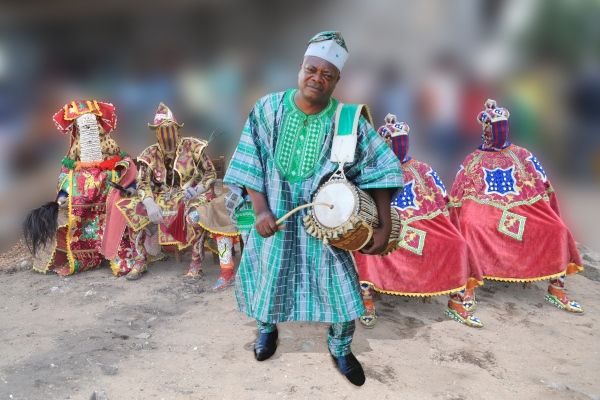
Benin is one of a few African countries where traditional rhythms and dances play an important part in everyday life. The country’s diverse music started under the Dahomey kingdom reign. The zinli, akinta, akohoun, tchinkoume, toba, agbotchébou, and kpanouhoun, which are still performed today, are mostly from voodoo cult dances and similar sources from back then.
Overview
The first generation of musicians emerged in1963. They were inspired by local rhythms to spread awareness, entertain and promote the gathering of ethnic groups. Yedénou Adjahoui is undoubtedly the most prominent figure of zinli, musical rhythm from the lands of King Béhanzin, which inserts an unprecedented early narrative, characterised by a captivating voice.
His cult song ‘Avidjè Agban mè’ continues to appeal to many,as he was able to bring impetus to the ‘Gohoun mass’rhythm. After his death in 1995, his successors particularly Dossou Letriki continued to lay claim to his songs.
Letriki’s self-titled album, recorded in 1984, highlighted the traditional melodies, played at events honouring the dead (Egoun - goun). Flagship titles included ‘Hindwa Bassi’ and ‘Maton Maton’,under the Albarika Store label, the only producer at the time.
Alékpehanhou is another prominent figure from South Benin, who released forty albums. He broke all sales records without much promotion. He played the zinli with a huge drum, gongs, rattles and clapping supported by songs and dances. These basic instruments were the first rhythmic sources of all genres in Benin. Alékpéhanhou was a mastermind.
Findings
Benin is definitely an untapped reservoir of traditional music. Although artists did not have a formal structure for artistic expression, they realized amazing feats making Benin a unique platform in this music category worldwide.
These artists released music with the help of several sponsors and state aid funds (Fonds d’aides à la culture FCC). They toured the country and performed at festivals, private events or funerals. They filled stadiums when they were together and mobilized the masses.
Several national and international institutions provided varied contributions to assist the intangible heritage because of its impact on socio- economic development. Many researchers and scientists worked to save these endangered songs and dances.
This is the case of the Conservatoire de Danses Cérémonielles et Royale d’Abomey (CDCRA)established in 1996 by a group of Beninese intellectuals, which was aimed at preserving and boosting this precious heritage. The Centre was supported by international institutions such as the UNESCO and the Program Civil Society and Culture programme (PSCC).
Diversity and traditional rhythms
The diversity of traditional rhythms was consistent with the gathering of ethnic groups from different regions. The most important groups were the zinli, akinta and akohoun, tchinkoume, toba, agboutchebou and kpanahoun.
They were valued in different ways and were the primary sources of revelry in the region. These artists all derived their inspirations from their regions to produce music with surprising similarities.
The Gankouékoué and Gankpèvi called Gon were the key parts mixed with other instruments to produce other sounds. These include the Yoruba dance from Kétou called “IWE " performed by the Agounwinwin Alade band; the Koutchati dance and Tibénti Perma from the north of Benin.
Ethnic inspiration
Beninese musical realities will not change anytime soon given their sad history. Specialists count sixty spoken languages. It would be risky to try to account for these traditional music groups because of their growing numbers. More than a hundred festivals are organized every year around these geographical areas with strong involvement of indigenous values.
Sociological impact
The weight of Beninese tradition, in enhancing the lives of the masses through songs, dances and traditional music is so important that it is urgent to save and protect them from exploitation for historiographical purposes. This is the concern of the Centre for Research and Documentation (CRD) of the Conservatoire des Danses Cérémonielles et Royales d’Abomey (CDCRA).
Economic impact
Benin is a stable country with unprecedented international openness. Its location should promote its cultural influence, but current development strategies do not attract as much attention.
Despite the political will and the unprecedented support in the provision of structural funding such as the Aid Fund for Culture (FAC) three to five billion CFA francs in 2015, the Beninese cultural actors refuse to question their strategy, learn and train.
Since the mighty Albarika Store, genuine producer of ancient glories, to Daghoty and the new generation ones like Lucas Koffi, Luc Akplogan, Oscar Kidjo Vidaho and others, not much has changed. Yet the sector would be better off if everyone was moving towards real professionalism. Traditional music is the top selling genre in Benin even though the products are not easily available throughout the country.
Evolution of traditional music
Reflecting on past musical practices, it is clear that Beninese traditional music is evolving. The best productions are adopting a more modern trend, with new artists like Anice Pepe, Adizé, Petit Génie, Norbéka and many others. Another category of traditional modern inspiration, with artists like Angélique Kidjo, Tohon Stanislas, John Arcadius, Gilles Loueke, Gangbé Brass Band, Jean Adagbénon, Nel Oliver and the guru Sagbohan Danialou have a more commercial approach and are becoming popular.
Beninese traditional music still plays a leading role in the development of the country’s promisingcultural sector. For it to be so, the authorities should encourage free enterprise and above all implement more infrastructure and efficient cultural facilities.
________________________________________
Source:
www.conservatoirebenin.bj
www.mdscbenin.org
www.babilown.com
www.afrisson.com
www.beninpresse.info/article
www.bj.jolome.com/news/le-roi-alekpehanhou
www.journal-adjinakou-benin.info
www.tourismeabomeyetregion.com/musique
www.awesometapes.com/yedenou-adjahoui
www.last.fm/music/yedehou+adjahoui


Most popular
Gambia: Suntou Susso announce UK tour for ‘The Path of a Griot’
09 Oct 2026

Top amapiano songs of 2026
16 Feb 2026
Open call: 2026 Gender@Work music industry training in Johannesburg
09 Oct 2026

Top Afrobeats songs of 2026
19 Mar 2026

Top Naija songs of 2026
31 Mar 2026

Call for applications: ACCES 2026 Emerging Artist Spotlight Competition
01 Oct 2026
Disclaimer: Music In Africa provides a platform for musicians and contributors to embed music and videos solely for promotional purposes. If any track or video embedded on this platform violates any copyrights please inform us immediately and we will take it down. Please read our Terms of Use for more.

Subscribe to our monthly Newsletter
Follow us on social media


Please log in to post a comment.