




























































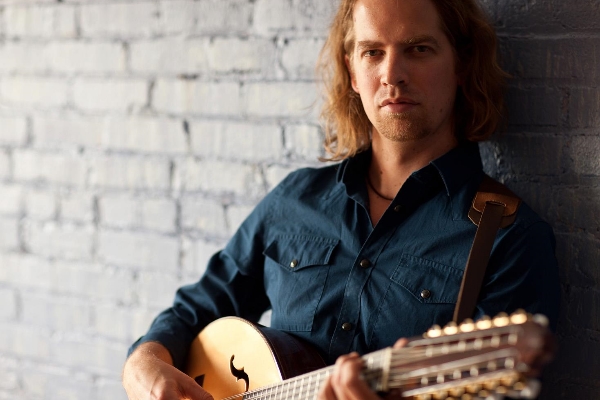


The guitar - arguably the most well-traveled and widely played instrument in the world - has played a prominent role in the development of African music over the past century, providing a medium through which African and Western audiences continue to engage. The distinctive approaches to the guitar throughout Africa provide insight into Africa’s musical diversity as well as the great changes it has undergone in the past century.

The guitar was likely brought to West Africa during Portuguese exploration, as early as the 15th century – though it wasn’t widely played until the establishment of colonial administration in the late 19th century. As its influence has grown, the guitar has adopted the roles and sounds of indigenous instruments, supplemented traditional ensembles, provided a musical bridge with the Americas and driven the development of urban dance music. By the mid-20th century, the guitar was a universal fixture in rural, town and city music, and had established distinctive and varied styles and approaches that fused indigenous, European, Caribbean, South American and Arabic music.
Musicians in Africa have expanded the instrument’s technical and expressive potential in several ways. First, they have demonstrated the creative potential of the non-chord driven approaches such as the widely used “two-finger” technique, which interweaves single line parts in cyclical patterns that capture distinctively African musical interplay. Second, they have shown how the guitar can embody the melodic and percussive language of a wide range of other instruments, such as the xylophone (ex. Mande balafon), spike lute (ex. Mande ngoni), harp (ex. Akan seperewa), and thumb piano (ex. Shona mbira). Third, African guitarists have developed an approach to soloing that is simultaneously supportive and melodic and expanded the guitar’s sonic palette with a range of techniques: finger-style, percussive palm-muted, electric lead, and funky chords and riffs.
North Africa: Sounds of the Sahara
In coastal North Africa, the guitar has been less influential than string instruments such as the Arabic oud and Gnawa guembri, which have maintained strong cultural and musical traditions tied to Berber culture (dating back to 1200 BCE) and Arab influence (beginning in the 7th century). However, in the desert regions of North and West Africa, the guitar has a strong presence. In the past decade, guitar styles of the Tuaregs (a subset of the Berber people who inhabit the Saharan dessert regions of Algeria, Mali, and Niger) have gained international attention.
The ishumar guitar style was developed by young Kel Tamasheq, who was displaced by drought and political instability in the 1970s. The band Tinariwen, founded in a Libyan refugee camp in the late 1970s, gained widespread attention with their album Amassakoul (2004), opening the way for other bands such as Tamikrest, Terakaft and Etran Finatawa. These bands shaped a guitar-driven sound that invokes Arabic melismatic melodies, the rolling rhythmic feel of North African music, and the drone of American folk-blues with the political and social messages of a people struggling with minority status in an increasingly instable region of Africa.
Tinariwen - Guitar riff from 'Toumast'
[audio:https://soundcloud.com/colter-harper/tinariwen-toumast autoplay:0]
The Saharan guitar style element that readily invokes wide open spaces and the slow pace of nomadic cultures is in the underlying feel, which cannot be accurately represented in either a 12/8 or 4/4 time signature. Listen to the guitar riff in above and notice how the melody is phrased so the second and third notes of each beat are slightly delayed to create an uneven, loping feel. Also, listen below to how Malian guitarist Boubacar Traoré shapes a two-finger approach to acoustic guitar that demonstrates a love of both American folk-blues and the minor pentatonic sounds of the Sahara. The interplay of bass and melody creates a feeling of constant movement though the song, and does not follow a Western harmonic progression
Boubacar Traoré - 'Adieu Pierrette'
[audio:https://soundcloud.com/colter-harper/boubacar-traore-adieu-pierrette autoplay:0]
West Africa: the home of Highlife, JùJú and Afrobeat
In coastal West Africa, the guitar has played an important role in highlife, jùjú, and afrobeat. Guitarist and ethnomusicologist John Collins explains how West African Kru mariners, employed on British and American ships during the 18th and 19th centuries, developed and disseminated throughout port towns the two-finger guitar technique known as “palmwine” guitar. This intimate sounding music was often performed in small, informal palmwine bars and followed harmonic progressions that reflected European choral harmonic influences.
In the figure sample below, you can hear the clear outline of a Western harmonic progression with the incorporation of the Akan recreational sikye bell pattern. However, there are certain palmwine guitar progressions that follow a modal movement between the IV and iii chords (F major and E minor in the key of C). This progression, called odonson, evolved as the guitar slowly replaced the Akan two-course harp called the seperewa. Examples of this style can be heard by proponents such as Ghanaian guitarist Koo Nimo and seperewa master Osei Korankye.
Palmwine Guitar - 'Yaa Amponsah'
[audio:https://soundcloud.com/colter-harper/palmwine-guitar-yaa-amponsah autoplay:0]
Developments of the two-finger approach were present with Nigerian guitarists, such as “King” Sunny Adé, who shaped a complex, layered talking drum and multiple guitar-driven music known as jùjú.
Likely the most ubiquitous African guitar style outside the continent is that of afrobeat, which is a high-energy blend of highlife, Yoruba music and American funk developed by the larger-than-life musician Fela Kuti during the 1960s and 70s. The guitar parts range from short, muted single-line patterns to jabbing, three-note chord riffs, and produce a hypnotic cycle that converses with melodic basslines and tight kick drum-driven percussion parts.
Central Africa: The Guitar Heroes of Congolese Rhumba
In the 1950s and 1960s, a form of guitar-driven dance music emerged in the two Congos (Congo and today’s DRC.) and grew to great popularity throughout Africa. Congolese rumba – also known as soukous, kirikiri and kwasakwasa – was the result of a dialogue between Lingala musical traditions and language, European brass band and Christian hymns, and Caribbean music.
In 1953, Joseph “Le Grand Kallé” Kabasele began to establish the modern Congolese sound with his band, l’African Jazz, which featured future solo artists such as Nicolas “Dr. Nico” Kasanda (guitar), Emmanuel “Manu” Diabango (saxophone), Tabu Ley Rochereau (singer), Sam Mangwana (singer), and Pepe Kalle (singer). In 1961, Kabasele established the Surboum African Jazz label, which release a series of albums by TPOK Jazz, led by one of the style’s most influential and celebrated musicians, Franco Luambo (guitar, vocals). In the 1970s, Congolese bands such as Zaiko Langa Langa brought a sound to Congolese music distinguished by the soaring sebene lines of guitarists such as Félix “Pépé Fely” Manuaku Waku.
As with highlife in West Africa, soukous generally follows a short progression outlining the I (tonic), IV (subdominant), and V (dominant) chords. Sebene lines are usually flat-picked single lines in the highest range of the guitar that simultaneously outline the harmonic progression, provide a rhythmic counterpart to lower supporting guitar parts and raise the energy of the music with soaring guitar lines. Few guitar styles in Africa feature individual virtuosity and the aesthetic of simultaneously accompanying and soloing as proficiently as soukous. Samples below show how the guitar sebene line uses both arpeggios and long glissandos to give the music a lifted, soaring quality while simultaneously interweaving a supporting part.
Congolese Soukous - Sebene Guitar Line
[audio:https://soundcloud.com/colter-harper/congolese-soukous-sebene-line autoplay:0]
Southern Africa: Mbira guitar of Zimbabwe
Several important guitar styles have developed in Zimbabwe. Like highlife and soukous, Shona guitar-band music became popular in the late-1960s and 70s, developing a distinctive style of guitar that drew from Shona mbira (thumb piano) and chimurenga (“songs of liberation”) music. The use of electric guitars, elements of Congolese rumba and traditional Shona music resonated with younger listeners during the politically-charged atmosphere of the War of Liberation (1964-1979).
Iconic Zimbabwean musician Thomas Mapfumo is credited for electrifying the mbira and working with guitarist Jonah Sithole to shape the chimurenga sound. As solo artists, and also with Mapfumo’s band The Blacks Unlimited, Sithole shaped a style of guitar playing that is indebted to soukous yet strongly connected to the spiritual and meditative music of the mbira. In the sample below, Sithole plays a guitar solo that maintains a dialogue with the mbira and bass while also interspersing high descending lines that mirror the vocal styles heard in mbira music. Though the music does not have the demanding high-energy drive of soukous, its groove is no less infectious. Also, the cyclical harmonic progression is based around mbira musical structures rather than European church or military music.
Thomas Mapfumo - 'Chitima Nditakure'
[audio:https://soundcloud.com/colter-harper/thomas-mapfumo-chitima autoplay:0]
New Voices in African Guitar
While the guitar has remained an important part of popular music in the USA, its use in contemporary African popular music has declined with the rise of vocally-driven, electronic dance music. For example, Ghanaian hiplife - a blending of highlife, hip-hop and the Twi language - gives occasional nods to highlife guitar but is driven by the lyricist. No longer is the guitar a representative of modernism and a medium through which Africa engages Western music. For younger generations seeking modern musical idols, the guitar often embodies an antiquated symbol of the post-colonial era.
Outside of Africa, artists such as guitarist and vocalist Lionel Loueke (Benin) and bassist, guitarist and vocalist Richard Bona (Cameroon) continue to demonstrate the guitar’s potential in bridging African musical traditions with Western musical styles. Both artists have developed the two-finger technique, incorporating modern jazz harmonies and bass/melody counterpoint in a manner that is both virtuosic and reflective of folk and popular music aesthetics.
Suggested Reading
- Collins, John. 2006. “‘African Guitarism’: One Hundred Years of West African Highlife.” Legon Journal of the Humanities 17, pp. 173–96.
- Eyre, Banning. 2003. “African Reinventions of the Guitar.” The Cambridge Companion to the Guitar, pp. 44–64.
- Kaye, Andrew L. 2008. “The Guitar in Africa.” The Garland Handbook of African Music, p. 88.
- Stewart, Gary. 2003. Rumba on the River: A History of the Popular Music of the Two Congos. Verso.
- Stone, Ruth M. 2010. The Garland Handbook of African Music. Routledge.
- Waterman, Christopher Alan. 1990. Juju: A Social History and Ethnography of an African Popular Music. University of Chicago Press.


Most popular

Top Naija songs of 2026
31 Mar 2026

Top Afrobeats songs of 2026
19 Mar 2026

Top amapiano songs of 2026
16 Feb 2026

Ghana: Mr Eazi and MOLIY’s ‘Comfort’ earns Urban Music Awards nomination
21 Oct 2026
Open call: CANEX Music Business Lab and Songwriting Camp
15 Oct 2026
Nigeria: CANEX WKND unveils 2026 programme
21 Oct 2026
Disclaimer: Music In Africa provides a platform for musicians and contributors to embed music and videos solely for promotional purposes. If any track or video embedded on this platform violates any copyrights please inform us immediately and we will take it down. Please read our Terms of Use for more.

Subscribe to our monthly Newsletter
Follow us on social media


Please log in to post a comment.