















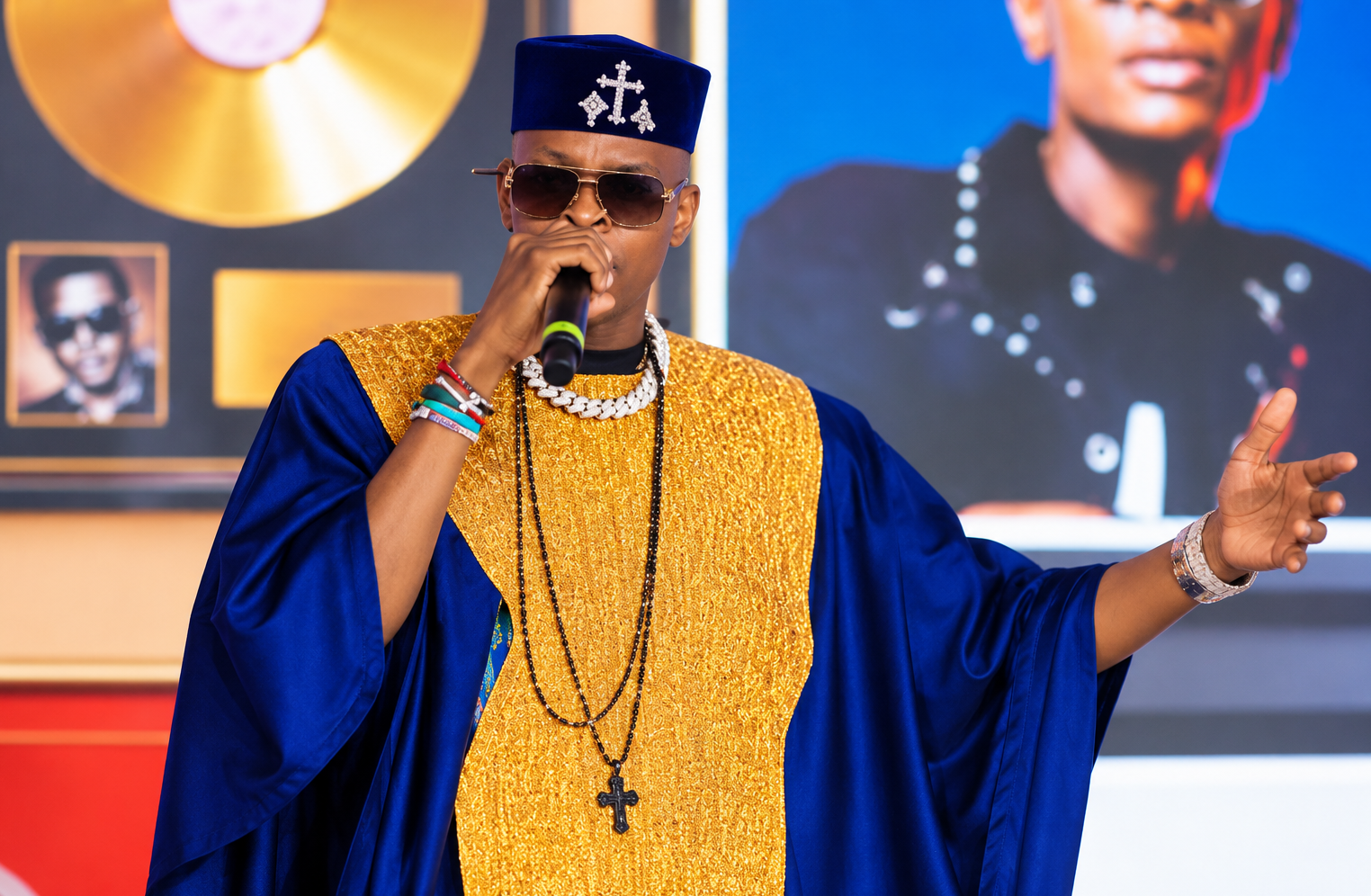


































by Tseliso Monaheng

On the morning of 28th October 2013 – a Monday – South Africa woke up to news that rapper Khuli Chana's vehicle had been shot at by the police after they mistook it for that of a kidnapper on the run. The incident occurred at a filling station in Midrand on Khuli's way to a show in Pretoria. "The current bullet count on the blue BMW 1 series vehicle that Khuli Chana was driving is seven. All seven were shot from the passenger side. Khuli Chana was the only person in the vehicle at the time of the shooting. A private forensic ballistic report is currently being conducted and will be made public once received," read the press release.
In the same week that he got chosen among GQ's best-dressed men, and the same weekend where he gave yet another impressive live performance in Soweto mere hours before the shooting, Khuli Chana's life nearly ended. It was another blotch in a long trail of police-related fuck-ups, a trail whose perpetrators tried to cover up their own misgivings by laying charges of attempted murder against Khuli[i].
The investigations have been finalised[ii], and the Director of Public Prosecutions' office shall reach a decision soon.
It's in the midst of all of this that we had a chat with him, at his recent video shoot for a song featuring Da Les and Magesh[iii]. Instead of discussing the particulars of his case, we tripped out over nineties hip-hop; broke down the science behind his flow; and discussed the recent resurgence of Morafe, the group he's been a part of since the mid-nineties.
Mahala: How did you manage to get Magesh on the song?
Khuli Chana: The song is inspired by a Magesh classic joint from his second album. That's been my favourite joint, so I kind of merged 'Hape le hape' with 'Time and time again' which is a Magesh hook. I used to always freestyle on that beat.
Let's talk a bit about your nineties influences. What shaped Khuli Chana?
The nineties kwaito, the nineties feel, the nineties boom bap, the hooks, the colours – I’m about that! The nineties' music was so authentic and so timeless. I'm down to experiment and try out some new things, but I'm still stuck in the nineties.
The Motswako movement wasn't always as lauded as it is now. What did it take to get here?
The end in mind. If you don't have a vision, you're screwed, and that's what we had. Today, I just wanna say that we're living HHP's dream. Everything that's happened, he predicted; it sounded like all kinds of gibberish back then. Big up to him.
There seems to be a Morafe resurgence going on, not that you guys necessarily left. What's the plan with that?
Like Towdee always says, 'Morafe never left the game/ we just changed how we played the game.' It got to a point where we were like 'we're not gonna be predictable.' You've got three geniuses, three talented cats. Let's start to dismantle and experiment. They experimented with me; I guess that was fuckin' awesome!
You had no label support when you came out, and resorted to releasing the music independently.
When we started up, I wasn't really down for the idea. It made sense, [but] I wasn't down for it because I was scared. I just didn't think I had it in me; Towdee was pushing for it. The guys that gave us that head start, big up to Skwatta Kamp, big up to Slikour and Ventilation. When we dropped 'Futhumatsa' on that [Sprite] Hip-Hoop mixtape [was] when I got that validation; that's when I got that 'whoa, you could do this!' That was pretty much Towdee's experiment. We worked on the joint, we sampled one of his verses. We did it, put it on that mixtape, and then boom, we were touring! We hit all nine provinces. That was an interesting time.
You're one of the few mainstream hip-hop artists who never sacrifice when it comes to lyrical content. What's the importance of lyrics, and how do you stay ahead of your own game?
Words man, words have power; they can either destroy or build. I don't write everyday; I wish I could, I wish I did. I put so much thought into that process. I never really know when it's gonna hit me, but when it does...it's a spiritual thing. Big up to the lyricists: Reason, Tumi, Jabba, Tuks, Towdeemac! Ba re lefoko ga le bowe, go bowa monwana – words stick. If you're gonna talk out of your bum now, think about how it's gonna impact the next generation.
Who influenced your flow, and how did it develop?
In the beginning, it was the pioneers of Motswako, [the likes of] Baphixhile. There was this rhyme pattern that was popular; everybody who was down with Motswako had that same (*mouths a rhyme scheme*) I was like 'okay cool, I'm down to switch' because Prof (Sobukwe of rap group Baphixhile) was always saying 'you're dope, but I want you to try it ka Setswana'. But I didn't like this pattern, this rhyme scheme. I'd like to hear a guy that has that Mos Def delivery, but spitting in Setswana. That's when I started experimenting. I remember it was a day, [Prof was] like 'listen, I'm off to Joburg, and when I come back, if you put me a hot sixteen, Imma put you on. I spat him a hot verse, and that's when it started. I'll be honest, ka Setswana it's always more challenging. I'd go months without writing because all I'm doing is I'm finding new slang; new slang, words. Just trying to find an opening line sometimes takes me a month, and it depends on where we're at.
You've had a very successful run over the past eighteen months or so, plus an unfortunate incident with the police. What's your state of mind right now, and going into the future?
It's a new chapter, we were talking about that le Towdee ke re you know what, sometimes you get to this place and you just have to acknowledge that everything you wanted to achieve, my whole list of goals I've literally scratched everything off. I’m just starting all over; it's a whole new journey now. Running a business is not an easy thing, and that's where I'm at right now. A lot of musicians blow up and become businessmen, and then the talent suffers. I wanna be just like a JAYZ who still raps like an eighteen year old, and the business sense and hustle is just as crazy. That's where I’m at.
What goes into preparing your live sets?
I wish we had more time. I've become so busy trying to balance fatherhood, work. I treat every show like a rehearsal; I'm always learning something new. Big up to my band – J-Star, Raiko, Maestro.
* Originally published on 18/02/2014 at: http://www.mahala.co.za/music/kicking-it-with-khuli/


Most popular

Top Naija songs of 2026
31 Mar 2026
Ghana: Mr Eazi and MOLIY’s ‘Comfort’ earns Urban Music Awards nomination
21 Oct 2026

Top Afrobeats songs of 2026
19 Mar 2026

Top amapiano songs of 2026
16 Feb 2026
Open call: CANEX Music Business Lab and Songwriting Camp
15 Oct 2026
Nigeria: CANEX WKND unveils 2026 programme
21 Oct 2026
Disclaimer: Music In Africa provides a platform for musicians and contributors to embed music and videos solely for promotional purposes. If any track or video embedded on this platform violates any copyrights please inform us immediately and we will take it down. Please read our Terms of Use for more.

Subscribe to our monthly Newsletter
Follow us on social media


Please log in to post a comment.