

































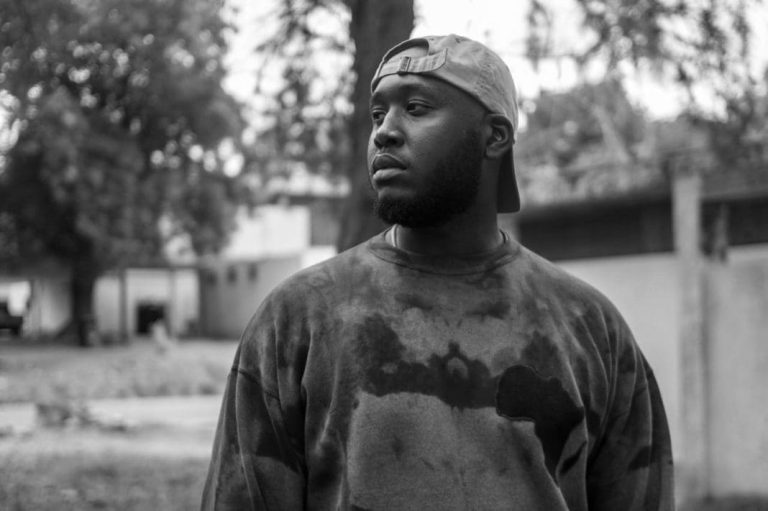
Jidenna in Lagos: The ‘Classic Man’ delivers classy performance

05 Sep 2016 - 11:37


"I need to put Jidenna's drink on the glorifier," says Amaka, tall, in heels, and minding her boyfriend.

What's a glorifier?
"Something you put a drink inside and it lights up."
So that’s what it's called. A conversation about a glorifier seemed a good introduction to Jidenna. Nigerian father. American mother. Rising popstar in America. Giver of a scandalous 2015 interview about Nigeria. Semi-forgiven by Nigerians. Singer of the glorified, certified jam 'Classic Man'. At this point, his much-awaited first-day-of-September concert, his first in Nigeria, is minutes late. Lagos is the leveller—everyone is late here, even Americans.
Celebrities dot the Hard Rock Cafe Lagos venue. The location for a D’Banj video and a Nollywood film set, Hard Rock Cafe is itself a kind of celebrity.
Hard-hitting hip hop pours out suddenly from the speakers into the hall: Instrumentals from Kanye West, Beyoncé and suchlike. Nearly every table in the hall bears a ‘reserved’ tag. Either for companies or for the rich (a ticket to the show costs 20,000 naira, approximately $65.) Amaka belongs to the table bearing the drink-making brand Pernod. There’s a Pepsi table and a Trace table. Both Pepsi and Trace are major supporters of the concert.
Amaka leaves her boyfriend—presumably to check on the glorifier. The crowd grows. The volume of chitchat increases—as does the number of selfies per second.
Enter: Cobhams and the Jidenna entourage
An hour later, the place is considerably full. No sign of Jidenna—unless the images from the screen hanging onstage count. The producer Cobhams Asuquo comes in led by a carer. A lady taps the carer and points upward. There's a table reserved for them. They follow her slim fingers. An hour and some minutes later, the Jidenna entourage shows up. It's quite an endless entourage. Some of the guys wear hats with red in them—like in the ‘Long live the Chief’ video.
DJ Spinall takes over the DJ stand. "I don't like when I'm playing people sitting, acting all bougie," he announces before playing Asa's ‘Be My Man’. And then he moves to John Legend's ‘Green Lights.’ The dance hits pile up. Tekno's ‘Pana’, Mr Eazi's ‘Skintight’, and so on. Spinall depends too much on the hits and not enough on a smooth transition. Already, the dance-ready sound of contemporary Nigerian music has halved his work.
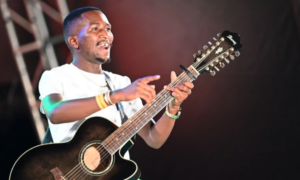
An hour to midnight, two hours behind schedule, the whole place is packed. It is Thursday but feels like Friday night at Hard Rock Cafe. A guitar-guy is the night's first performer. The volume of chitchat competes with his guitar, but dude keeps going. He gets applause as he finishes.
"I didn't know that was going to be so quick," DJ Spinall says as he gets back to playing the hits. "Shout out to Beverly Naya in the building. Shout out to all the beautiful ladies in the building."
Mr Eazi shows up
The main opening act is Mr Eazi. Skinny, white top, black pants, raffia hat on his back like in the videos. With his deep and drowsy flow, he sings his song with DJ Spinall, ‘Ohema’. "If you know the song join me and vibe," he says as he introduces Godwin, a guitar guy standing by.
He goes through reggae songs by Bob Marley and Majek Fashek. And then it is time for his own song ‘Dance For Me’. The acoustic version travels well but is nothing compared with when DJ Spinall takes over from Godwin. The girls dance as he commands: they shoki, they do the alkayida, they dab. He sings ‘Hollup’, ‘Anointing’, and closes with ‘Skintight’.
"I want to thank everybody who loves Afrobeats," a representative from Trace says after Mr Eazi’s exit, using the locally conflicted term. "Because of Afrobeats music, we are launching a new channel called Trace Naija. You know what: we love Afrobeats." It is not quite clear if he is saying afrobeat or Afrobeats.
A video tracing Fela’s afrobeat to today’s Nigerian and African music comes on. Shame because although handsomely shot, the connection from Fela to what you hear on Nigerian radio today—except for specific songs—is rather thin. As Don Jazzy and DJ Jimmy Jatt said in a recent interview: [Fela’s sound] is not our sound. The video itself shows a flattening of today’s African music. Africa is either a country or a genre. Other than geography, what connects the music of Mi Casa to MI Abaga to 2Baba to Sauti Sol? As though in protest, the sound of the video goes out.
Chief Jidenna runs
At midnight, three hours late, Jidenna runs onto the stage as ‘Chief Don't Run’ plays. Even the Chief must run in Lagos, it seems. Suit, waistcoat, long sleeved shirt, cufflinks. This is what it takes to be a classic man—three layers of clothing in a packed arena. The sweat will come later.
He is surrounded by one dancer and three instrumentalists who double as dancers on occasion. He sings ‘Knickers,’ and then an unfamiliar song has him take off his coat. Then it is time for his one true Afropop jam, ‘Little Bit More’. The crowd screams and dances. Onstage Jidenna does some moves, twisting his lips as Nigerians do dancing. When he gets to the song's last minute where he sings in pidgin, Jidenna flashes a knowing smile.
"My name is YankyBanky," he says laughing at the end, referring to the name Don Jazzy handed him on Twitter. "aka Yellow Boy who brings AK 47s and nuclear weapons...I came prepared this time." A product of two worlds, his speech sounds very Nigerian, different from both his music and his foreign interviews. He may be more classic chameleon than man, this Jidenna.
The crowd laughs politely at this joke. It looks as though Nigerians still aren’t sure if the interview where their Nigerian-American brother says he comes to Nigeria protected with guns to foil kidnappers is worth surplus laughter. Yet it’s understandable that Jidenna wants to play the scandal for jokes. "Nigeria is the most hospitable country in the world," he concludes.
If he intends this as consolation, then Jidenna is the kind to insist on paying for sins.
Long live the Chief
Before launching into another song, he makes more jokes, mainly about his Igbo father. Paul of P-Square, in between selfies with ladies, laughs at the jokes. The next song is "in honour of my father the real chief, the big chief," Jidenna says before going into the forthcoming album’s title track ‘Long Live the Chief’.
Afterward, he sips a drink, certainly from the glorifier, glass in left hand. The songs come and go; his main dancer transforms from dancer to seducer to clown—sometimes all three on a single song. At some point, all five men onstage jump, cutting an image of young men at a playpen. Thirty minutes into his set, Jidenna goes offstage. He’ll be back: He’s yet to sing ‘Classic Man’.
The 'Classic' conclusion
He returns with a cane, tiptoeing across the stage. Funny guy. "My band makes it look easy,” he declares. And then Burna Boy comes on to sing ‘Yawa Dey', his own hit from a few years ago. Jidenna becomes Burna’s backup singer. "My Igbo brother," Burna Boy says later, hugging his host. Some banter ensues.
"One of my favourite artists, Burna Boy," Jidenna says. "He doesn't wear a mask."
All through his seamless session, Jidenna speaks to his audience from the stage. Although friendly and funny, he never steps down from the stage into the crowd. He resumes his set with his breakthrough jam, 'Classic Man'. Here, the song sounds like one declaring independence from women—"Even if she go away...I'm a classic man"—almost like a consolatory song for the heartbroken. Jidenna stops to preen. Massages hair, adjusts shirt, pulls beard. Funny guy. For his next song, he ruffles his own hair—which manages to look pretty even in its dishevelled state. "You thought it was a perm didn't you," he calls out in vain mischief. He then offers two more songs, the last being 'Extraordinaire'. The forthcoming album, it appears, will be chockfull of hits. Whatever the case, Jidenna's first Lagos concert is a hit.
"Thank you Hard Rock Cafe!" he shouts. His audience cheers. The man goes offstage, disappearing an hour after his voice first hit Hard Rock Cafe.
A number of celebrities materialise at the back of the hall: Wizkid wearing a black t-shirt, Paedae of R2Bees wearing a scowl. Both pose for photos. It is their turn to shine. The night's true star, the Classic Man, has left the building.


Most popular

Ringing cancer’s bell: How Umjondi became a story of friendship, grief and hope
26 Jun 2026
Dwin, The Stoic: Master of ballads, architect of connection – part 2
26 Jun 2026

Tycoon releases ‘Art of Love III’ ft. Kabza De Small, Kelvin Momo
26 Jun 2026

Morocco: ElGrandeToto expands ‘SALGOAT Vol. 2’ with extended edition, new international collabos
26 Jun 2026

Kabza De Small tops 2026 SAMAs nominations
26 Jun 2026

Deezer launches Remix Lab, allowing fans to create authorised song remixes
25 Jun 2026





Disclaimer: Music In Africa provides a platform for musicians and contributors to embed music and videos solely for promotional purposes. If any track or video embedded on this platform violates any copyrights please inform us immediately and we will take it down. Please read our Terms of Use for more.

Subscribe to our monthly Newsletter
Follow us on social media


Please log in to post a comment.