
























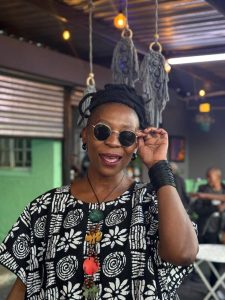























Maia von Lekow : Growing out of her legendary father’s shadow

26 Nov 2014 - 15:11


By Stanley Gazemba
Her father, Sal Davis, was a ground-breaking international star in the experimental heady seventies when the famed Nairobi ‘boogies’ were in full swing. It would seem like the genes were passed on to the daughter. But unlike what many believe, Sal Davis did not mentor Maia von Lekow. She has had to hustle her way up in the music business like everyone else. Like the other musicians, she is grappling with the challenge of distributing her music, given there are no nationwide distribution channels to speak of, save for the River Road distributors, who she is keen on working with.

In an interview Maia revealed that she was raised by her mother, Maggie von Lekow, and that from age three she rarely saw her father. It is only recently that they reunited and started forging a bond. “He was always the person I heard about but never saw,” she said. But she admits that what she heard about him inspired and shaped her career.
Maia’s musical journey is a complex one. Born and brought up in affluent Ridgeways in Kiambu where the musical repertoire in the house was Nina Simone, Ellah Fitzgerald, Simply Red and other western jazz acts, and having gone to prestigious schools makes her attempt to craft authentic Kenyan music especially challenging. Her mixed parentage makes it no easier. Her father is from Mombasa and her mother is half German and half Italian. This mixed parentage and her quest for an identity is what inspired her twelve-song album Drift.
“Initially it was bothering me because I wasn’t black, and I wasn’t white either,” she said. “Every time I performed before a foreign audience they would see me as a black musician, and for a local audience they would see me as white. I was trying to find out where I fit. I was sometimes embarrassed by my white side, for instance; and then I would be embarrassed by the fact that my father is from the coast and yet I cannot speak Swahili fluently. I am now finding the positivity of both.”
This drifting between races is what partly gives the album its title. But it also draws from the fact that her music drifts between the various places around the world where she has lived and worked, both as a musician and a hotelier. At some point she lived and worked in Tanzania, Australia and Europe, and from all these stops she soaked up a little of the musical culture, which worked itself into her music.
“I categorize my music as music in progress,” she said when asked about her genre. “It has been influenced by Afro, jazz and many other styles. I want to keep trying to absorb as much as I can.” She expects to continue with this experimentation with different styles. Her only worry is that it may change her voice and style.
The making of Drift is another story all together. It was initially set to be recorded at Kassanga Studios in Nairobi. But then as they progressed the bills kept piling and she realized she was not going to finance it to the end. She therefore contacted a producer, Nicco Berthold, who she had befriended in Australia. It happened that Nicco had been planning to come to Kenya on holiday, and he agreed to bring along his equipment and record her for free. The album was thus partly recorded in her living room and various other places like people’s garages. “We recorded the whole thing in one week. And then Nicco took his holiday the following week.”
But Drift is not her first album. She has also recorded a compilation self-titled eight-track album. However, the songs in this collection were done with the various other musicians she had been working with in Kenya and in Australia. Ennovator Music’s Tim Rimbui recorded one of the songs, Uko Wapi. She would rather have Drift as her official debut album because all the songs on it were written by herself.
As an only child, her mother was initially reluctant about her making a career in music. “She wanted me to choose something where I would be able to make some money, hotel management or something like that.” All the same she wasn’t exactly discouraging, engaging a voice trainer for her while still studying at Peponi School. “At one point I wanted to play the clarinet and she got dad to help me buy a second-hand one.”
After school she worked to save money to go to Europe, where she sang on the streets for loose change -- busking, as it is called. It is these solo a’capella acts for strangers that helped her overcome her fear of the stage that she had suffered growing up.
Later, she moved to Australia to study Hotel Management. It is here that she started playing in bands, even as she learnt to play the guitar. She has been playing professionally for a while now, occasionally appearing on stage with her father. She is also keen on learning the technical aspects of music. “Sometimes we could be practicing with someone I haven’t worked with, say a jazz guitarist, who would suddenly say, ‘Gimme a six eight…gimme a six eight’. I had no idea. I’d like to learn more music theory.”
Although she started out appearing alongside Kato Change as an acoustic duo, she has since broadened her band to include Danz on the bass, Nathan Okite on guitar, Wakake Otieno on percussion, and Amani Baya on the drums. Moses Muthungu and Andew Ngatia usually trade places on the keyboard depending on their availability.
Although she discovered Manu Dibango, Ayub Ogada, Joe Mwenda and Papa Wemba much later in life, Maia believes there’s lots of good music around that should inspire upcoming musicians. “A lot of us are trying to learn what musicians from the west do, and yet we have lots of good music here,” she said.
Besides Europe and Australia, she has performed at Sauti za Busara, The Great Rift Valley Festival, HIFA(Zimbabwe), and Blankets & Wine, among other places. One of the biggest challenges she faces locally is distribution of her music. Currently she sells her CDs at Dormans coffee shops and during shows, assisted by her fiancée. Her videos can be viewed on her website: www.maiavonlekow.com.


Most popular

Ringing cancer’s bell: How Umjondi became a story of friendship, grief and hope
26 Jun 2026

Dwin, The Stoic: Master of ballads, architect of connection – part 2
26 Jun 2026

Tycoon releases ‘Art of Love III’ ft. Kabza De Small, Kelvin Momo
26 Jun 2026

Morocco: ElGrandeToto expands ‘SALGOAT Vol. 2’ with extended edition, new international collabos
26 Jun 2026

Kabza De Small tops 2026 SAMAs nominations
26 Jun 2026

Deezer launches Remix Lab, allowing fans to create authorised song remixes
25 Jun 2026






Disclaimer: Music In Africa provides a platform for musicians and contributors to embed music and videos solely for promotional purposes. If any track or video embedded on this platform violates any copyrights please inform us immediately and we will take it down. Please read our Terms of Use for more.

Subscribe to our monthly Newsletter
Follow us on social media


Please log in to post a comment.