























































By Elias Gebreselassie
Although the state controls most broadcasting outlets, including the sole national television network, there are a few private radio stations in Ethiopia. This text provides an overview of the media landscape in the East African nation, particularly as it relates to the country's music industry.
History
Towards the end of the 19th century, missionaries and trade representatives set up weekly and monthly papers in French. The first publication to be introduced was a weekly newspaper (La Se-maine d' Ethiopie, 1890), published in French by a Franciscan missionary living in Harar. In 1905 the name of the publication was changed to Le Semeur d'Ethiopie[i].
The first Amharic newspaper was issued in 1895, a four-page weekly newspaper named Aemero (intelligence). The first issues of Aemero were hand-written, but by 1902 the paper had a weekly circulation of more than 200 copies as it was printed using mimeograph machines. The paper ceased publication in 1916 but was later revived in 1924 before collapsing again after a few years. Between 1912 and 1915, weekly newspapers like Melekete Selam, Yetor Wore (‘War News’), and many others emerged. In 1923, Emperor Haile Selassie I established the first printing press, Berhanena Selam (Light and Peace).
Between 1923 and 1936, Ethiopia had six publications: Aithiopicos Kosmos (Ethiopian World) in Greek in 1925, L’EthiopieCommerciale in French in 1932, AtbiaKokab (The Morning Star) in Amharic in 1934, and from 1934 to 1936, Ye-Ethiopia Demts (Voice of Ethiopia) in Amharic. Ye-Ethiopia Demts was silenced by the Italian aggression on Ethiopia and was reissued in 1958.
In the three decades after liberation (between 1941 and 1974), a number of legal measures we taken that encouraged the growth of the print media in Ethiopia. The major ones were: the decrees of 1942 and 1944, the Revised Constitution of 1955, the Penal Code of 1957, the draft constitution that was presented to the country’s highest constitutional assembly in July 1974, and a decree published in Addis Zemen in March 1975. A year after the formation of The Press and Information Department, in 1943 The Ethiopian Herald[ii] was started as a weekly, published in English. This newspaper and Addis Zemen became dailies at the end of 1958, and are still being published by the Ministry of Information to this day.
More quarterly and annual departmental journals and publications emerged. These included publications by the State Bank of Ethiopia and various government ministries. Magazines too were published during this period. Some of these monthly magazines were: The Ethiopian Mirror (English), Menen (one each in English and Amharic), Addis Reporter (English) and others published by the Ministry of Information.
The first two or three years of the Derg regime (1974-1987), often referred to as “the golden era” by Ethiopian journalists, held much promise and hope of freedom of the press. Dialogues between opposing political groups were seen in print and electronic media, and journalists became extremely open and critical of the government. Relevant national issues such as democracy, land tenure and the form of government the country should have were openly discussed in the public print media.
The landmark event in the history of print media in Ethiopia began after the Ethiopian Peoples’ Revolutionary Democratic Front (EPRDF) came to power in May 1991. The EPRDF soon declared the adoption of the 1948 Universal Declaration of Human Rights, which ensured freedom of the press and speech. The Ethiopian publishing industry mushroomed after the Press Bill of 1992. Figures differ, but according to the Government, 385 publications were registered between October 1992 and July 1997, of which 265 were newspapers and 120 magazines.
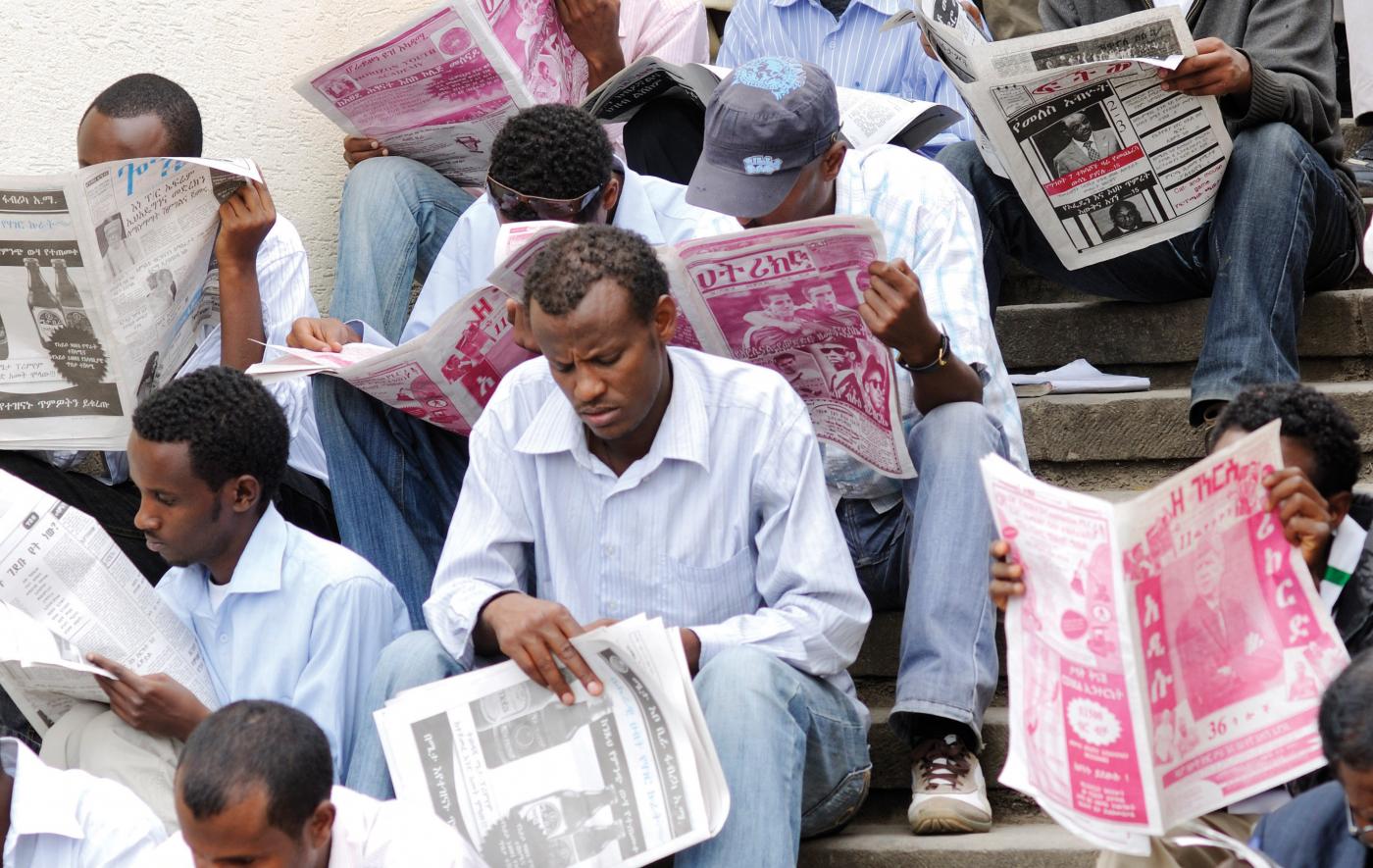
Presently Ethiopia lacks substantive dailies. Saturday and Sunday are popular distribution days for the country’s, weeklies and monthly publications. That also makes it the toughest day to find an empty news seat in Arat Kilo, where the largest publishing house is located, or anywhere on the streets of Addis.
The daily news publications Addis Zemen and Ethiopian Herald are read mainly for their job vacancies and advertisements but include a page dedicated to entertainment, including general information, interview with prominent personalities, poems and music news.
The privately owned Ethiopian Reporter[iii] newspaper is published three times a week: in Amharic on Wednesday and Sunday and in English on Saturday. It has by far the most polished sections dedicated to music and entertainment. Capital and Fortune[iv] are privately owned weeklies that focus on business news in English. Both publications typically have a page dedicated to general entertainment. Many newspapers close down not long after opening due to low circulation, lack of advertising revenue and high printing costs.
Radio
Radio is the main source of news and information in Ethiopia, especially in rural areas where 80% of the population live. According to a 2011 survey by Electoral Reform International Services (ERIS)[v] music was a second choice for most radio listeners with 14% of women and fewer than 6% of men listening to music programs. The single most popular national radio program identified by the ERIS survey was Radio Ethiopia’s Ehud Meznagna (Sunday Entertainment) program. Radio Zami’s[vi] Ethiopika Link entertainment program is also popular amongst youth. The show features music, films, and celebrity gossip and love issues.
According to the Ethiopian Broadcasting Authority[vii], an autonomous federal agency tasked to regulate the broadcast media, 26 shortwave and FM stations and nine national and regional TV stations exist in Ethiopia.
Radio EBC[viii] functions as a main entertainment radio outlet in Ethiopia. It covers lifestyle and financial issues. The station broadcasts in Amharic. Radio 104.7 FM is an English spinoff of Radio EBC. It is restricted to Addis Ababa and caters to Ethiopia’s intelligentsia as well as the substantial diplomatic and NGO community in the capital.
Radio Afro[ix] FM 105.3 is the main hub of African music, politics, news and broadcasts in English. Radio Afro also features a one hour daily French Show. The station was created under its parent organization Paconet Media PLC in 2008, covering a 150km span to Addis Ababa and its surroundings.
Sheger Radio[x] also presents great African music. Launched in early 2007 and owned by a prominent media personality Meaza Biru and her husband Abebe Balcha, Sheger is Ethiopia’s first privately owned radio station. Its programming sprinkled with 'infotainment' programs and fresh news has made it a popular attraction for many listeners. The channel broadcasts multilingual content.
Television
Ethiopian television was established in 1964 with assistance from the British firm, Thomson. It was created to highlight the Organization of African Unity (OAU) meeting that took place in Addis Ababa that year. Currently known as the Ethiopian Broadcasting Corporation (EBC)[xi], the station’s programming includes news, sport, music and other entertainment. It broadcasts in Amharic, Oromo, Somali, Tigrinya, Afar, Harari, as well as English.
EBC has entertainment programs like Balageru[xii], which features similar content to that of the US show American Idol, in addition to dancing competitions. The talent show, which started in 2005 as Ethiopian Idol, is produced by renowned music producer Abraham Wolde. It combines separate singing and dancing competitions. Another show, called Merewa[xiii], is modeled on the US show The Voice and has also recently started screening on US-based Ethiopia Broadcasting Service (EBS), giving a chance for aspiring singers. Ethiopia’s regional governments - primarily in Oromiya, Amhara, Tigray and Southern region – also have their own TV stations
Online
Ethiopia is ranked as having one of the lowest internet and mobile phone penetration rates in Africa. The government has kept the internet and mobile technologies under strict control in order to closely monitor the information accessed. Access to these services relies solely on the state-owned telecommunication operator, Ethio Telecom. Although the government has recently undertaken major infrastructural initiatives in many areas, Ethiopia remains one of the least connected countries in Africa, with only 1% of Ethiopians having access to the internet. This is largely due to Ethio Telecom’s monopoly, which makes internet access relatively costly, slow and unreliable, with coverage limited outside the capital, Addis Ababa.
Despite restrictions, a community of online platforms has emeged to share the county’s music. These include Hubesha[xiv], Tigrai Online[xv] and Habesha Zefen [xvi], which feature works by various Ethiopian artists
Freedom of speech
Ethiopia’s 2005 election was the country’s most closely contested ever. The government alleged that journalists and editors were part of a conspiracy to overthrow the government. This left the free press, which was slowly expanding for the first time since the ruling party took power in 1991, under attack. The government started taking repressive measures against freedom of expression and association.
Ethiopia’s Anti-Terrorism Law was adopted in 2009[xvii]. Since then, the independent media have been decimated by politically motivated prosecutions under the law. In 2012, Hailemariam Desalegn became Ethiopia’s prime minister following the death of Meles Zenawi, under whose leadership the country experienced a sharp decline in civil and political rights – including freedom of expression. Hopes that Hailemariam’s government would improve Ethiopia’s record on free expression were dashed by arbitrary arrests and detentions of journalists.
In April 2014, Ethiopia jailed bloggers and journalists from Zone 9 on terrorism-related charges. They were released after more than a year of imprisonment. To avoid arrest, 30 journalists fled the country that year. Besides journalists, Ethiopian musicians often tend to stay clear of politically tinged music. Popular Ethiopian singer Tewodros Kassahun (aka Teddy Afro[xviii]) was an exception when in 2005 he released an album that was critical of the government to wide acclaim. As recently as December 2015, there were unverified reports that the Ethiopian government had banned songs from several Oromo singers because of their politically charged nature.
Despite the above restrictions and challenges, Ethiopia’s media sector has evolved over the past century and does give some support to the country's vibrant music industry.


Most popular

Call For Applications : ACCES seeks a UK-based performer
10 Sep 2026

Top amapiano songs of 2026
16 Feb 2026

Top Afrobeats songs of 2026
19 Mar 2026

Open call: Goethe-Institut grants for Southern African creatives
08 Sep 2026

AFRIMA 2026: All the winners
12 Jan 2026
Open call: Ernst von Siemens Music Foundation 2026 funding programmes
04 Sep 2026
Open call: FAME Week Africa, Pressure Cooker Studios songwriting camp
09 Sep 2026
Disclaimer: Music In Africa provides a platform for musicians and contributors to embed music and videos solely for promotional purposes. If any track or video embedded on this platform violates any copyrights please inform us immediately and we will take it down. Please read our Terms of Use for more.

Subscribe to our monthly Newsletter
Follow us on social media


Please log in to post a comment.